

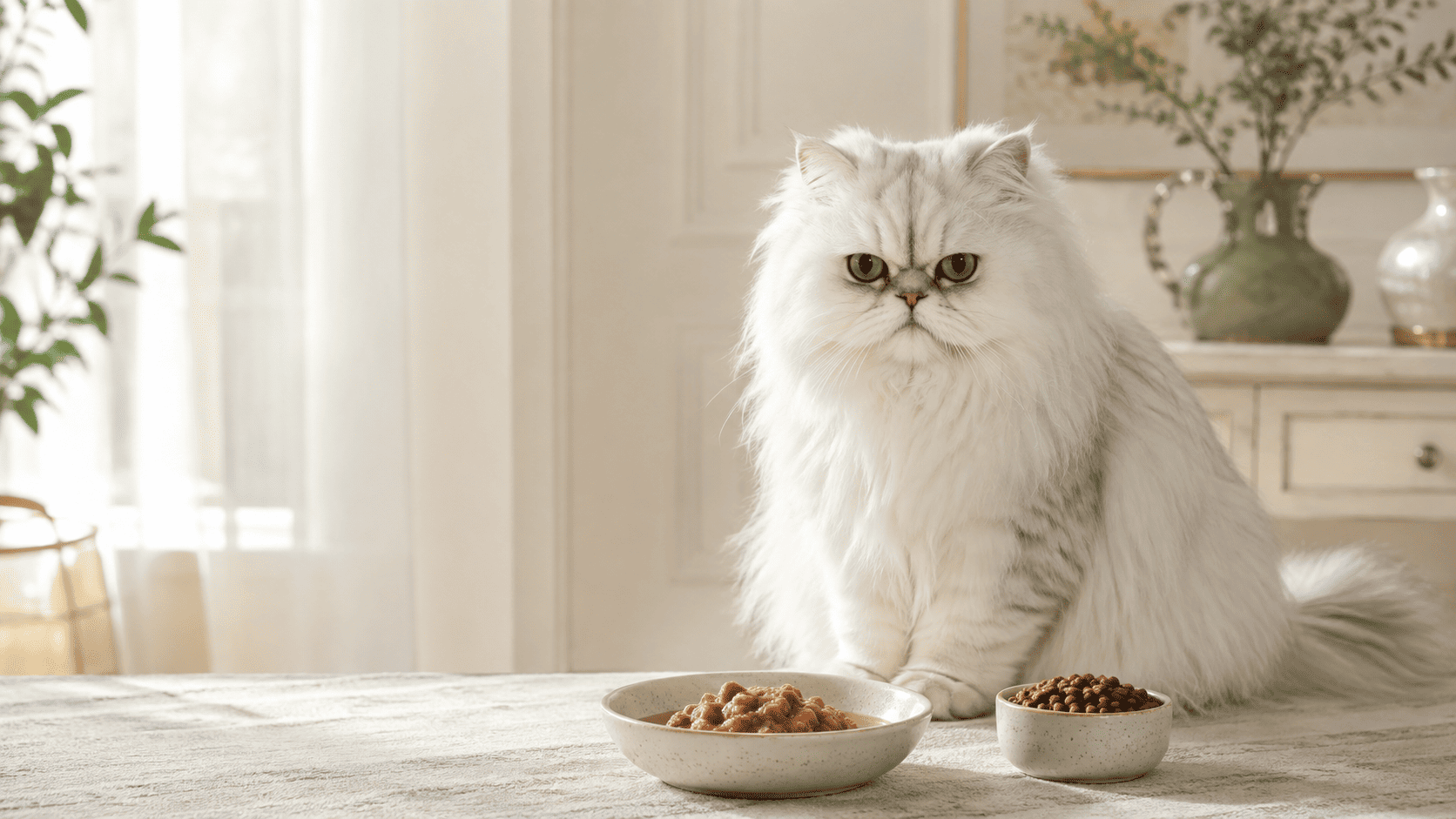
Persian cats are known to be loving, gentle, and high maintenance, perhaps no trait is as evident when it comes to their meals. The Persian cat's distinct face structure, long, silk-like fur, and sensitive stomach make finding the best food for Persian cats not simply a matter of picking out a bag with the name "Persian" emblazoned on it. It is important to know the ins and outs of how the body of a Persian cat operates.
If you have been seeking the best food for Persian cats, this guide highlights what you need to know about Persian cat food, the important nutrients for Persians, what to avoid when feeding your cat, and what the Zoomies brand brings to the table in 2026.

Why Persian Cats Need Special Nutrition

It is crucial to get acquainted with the main distinguishing features of this breed to choose the best food for Persian cats.
1. Brachycephalic (flat) face conformation.
Persian flatness alters the mechanism by which a cat catches and chews food. Due to the special shape of kibble, a Persian cat may have difficulty biting food due to the peculiarities of its anatomy and eat kibble in one go. It can lead to a slower stomach clearance, vomiting and hairballs formation – and these reasons explain why the shape and structure of kibble play such an important role in choosing the right food for Persian cats.
2. Demanding mono-layer coat.
Different from double coated breeds, Persian cats have single layer fur which consists of ultrafine and very long hair. Such fur requires daily feeding of animal-based fatty and amino acids to remain healthy, glossy and not matted. Nutritional deficiencies first become apparent in coat condition.
3. Genetic susceptibility to kidney and urinary problems.
Being genetically sensitive to kidney and urinary problems, such as PKD (polycystic kidney disease), Persians require proper hydration.
4. A tendency toward obesity.
Persians are typically low-activity, indoor-only cats, so portion control and calorie-dense-but-balanced meals matter more for this breed than for more active cats.
These four factors are why generic "adult cat food" often isn't enough, and why so many owners specifically search for the best food for Persian cats rather than settling for whatever is on the supermarket shelf.
What Makes the Best Food for Persian Cats

When you're comparing the best cat food for Persian cats, look past the marketing on the front of the pack and check these fundamentals:
|
Factor |
What to Look For |
Why It Matters |
|
Protein source |
Named animal protein (chicken, fish, lamb) as the first ingredient |
Cats are obligate carnivores and need animal-based amino acids, not plant fillers |
|
Protein % |
Roughly 35%+ on a dry matter basis |
Supports lean muscle, energy, and coat quality |
|
Moisture content |
Wet food, gravy, or bone broth-based formats |
Persians are prone to kidney and urinary issues and often under-drink from a bowl |
|
Fat & Omega fatty acids |
Omega-3 and Omega-6 fatty acids |
Directly feeds the coat's shine and reduces shedding and matting |
|
Texture/kibble shape |
Small, easy-to-chew kibble or wet/minced formats |
Accommodates the Persian's flat-faced jaw structure |
|
Ingredient transparency |
No artificial colors, unnamed "meat meal," or excess fillers |
Reduces digestive upset and allergic reactions |
|
Hairball support |
Added fiber or hairball-control formulas |
Helps move ingested fur through the digestive tract |
Any product genuinely marketed as the best food for Persian cats should check most, if not all, of these boxes, not just one or two.
Wet Food vs. Dry Food: Which Is Better for Persians?

This is among the most prevalent concerns raised by pet owners in their efforts to determine the most appropriate food type for Persian cats, and the truth of the matter is that both types have their respective uses.
Wet food helps increase hydration, provides a milder option for the jaw structure of a Persian cat, improves kidney and urinary health, and is also easier for Persian cats to consume without difficulties.
Dry food has the ability to help promote some level of dental hygiene, provides more convenience since it can be left out, and also lasts longer, provided the kibble is the right fit for the jaw structure of a Persian cat.
A combination of wet or fresh food together with dry food in smaller quantities has been recommended in recent times for Persians. The use of dual wet and dry food for Persians has become more common in 2026.
How Much and How Often to Feed a Persian Cat

It is better not to give Persian cats one large meal a day but two to three smaller portions because this will help to keep the digestive system healthy and avoid the formation of extra weight that is typical of Persians. Young Persians require even more frequent feedings per day because it helps them to grow healthily and normally. One should take into account the feeding directions given on the package of food for Persian cats at first. After this, it is necessary to pay attention to how the body condition of the cat changes. It should be possible to touch the ribs without applying any effort and see a waistline when looking at the Persian from above.
Ingredients to Avoid in Persian Cat Food

Even when your product claims to be one of the best cat foods for persian cats, make sure the list of ingredients does not include:
-
Onions, garlic, chocolate and eggs (these are all poisonous and harmful for your cats)
-
Ingredients that read "Meat by-products" or "Meat meal" without specifying what kind, and without being the second or third ingredient listed
-
Colors and additives
-
Lots of plant fillers such as corn, wheat or soy which are added to lower the cost of production
-
Formulas with too many carbohydrates because Persian cats just like all other cats are obligate carnivores
Best Cat Food for Persian Cats in India: What to Know

Indian pet parents searching for the best cat food for persian cats in india face a few extra considerations that owners in cooler climates don't:
-
Challenges related to heat and cold chains. Summer temperatures in India might strain the cold chain for fresh/raw food, especially in tier-2 and tier-3 cities, hence the need for proper storing and consumption right after opening such products compared to temperate countries.
-
Variety of prices. There is quite a price gap between mass kibble and top-quality fresh/wet food. Quite a lot of cat owners are currently moving from cheap options to more expensive mid-level products that offer both affordability and nutritional value.
-
Hazards of homemade diet. Common ingredients used in most households in India – onions, garlic, too much spices, and a lot of dairy products – are often unknowingly used by cat owners as treats for their pets, but none of these are good for a Persian's stomach.
-
Rising interest in healthier alternatives. In 2026, pet owners in India have become more aware of healthy options, thus are looking for alternatives to traditional dry kibble when picking the best cat food for Persian cats in India.
Popular options available in the Indian market span the full spectrum, from mass-market dry kibble brands to breed-specific formulas to newer fresh and wet food brands — which is exactly where a brand like Zoomies has carved out its space.
Zoomies Cat Food: A Fresh Approach for Persian Cats

When it comes to choosing between the most nutritious food for persian cats, Zoomies has emerged as an alternative brand that is more natural as compared to regular kibbles. Instead of opting for highly processed food, Zoomies is concentrating on the natural wet food along with its bone broth formulas that help provide moisture and enhance flavor and digestibility of a cat's everyday diet.
Here's why Zoomies cat food is worth considering for Persian cat owners:
-
Formulas with high moisture content. The fact that Zoomies have natural wet food and bone broth versions means they help bridge the gap of water deficiency that is usually found among many Persian cats.
-
Trial packs. This feature helps introduce Persian cats to a different kind of food gradually using their adult and kitten cat trial packs containing wet food as well as treats because of the need to introduce them gradually since abrupt diet change may cause an upset stomach among Persian cats.
-
Reduced use of fillers. The brand promotes itself by trying to "fix what's broken in pet food" by avoiding meat products or grain fillers and emphasizing natural ingredients.
-
For sensitive cats. Besides, for Persian cats suffering from allergies or problems with the coat, Zoomies also produces formulas resembling hypoallergenic food.
-
India-centric delivery and freshness focus. As Zoomies is operating and delivering in India only, this brand caters to the conditions that are peculiar for Indian deliveries and storage, thus being a good option for a wet or fresh food brand aiming to become the best cat food for persian cats in india.
If you're weighing the best food for Persian cats and want to move your cat toward a fresher, less processed diet without the guesswork of building a homemade plan, a Zoomies trial pack is a low-risk way to test how your Persian responds before committing to a full switch.
Signs Your Persian Cat's Food Is Actually Working
Even after choosing what you believe is the best food for persian cats, keep monitoring these visible signs:
-
Soft, shiny coat that shows little matting between baths
-
Healthy weight without being overweight or underweight and a defined waist
-
Good energy level for a home-based cat breed (Persians are laid-back breeds, but they are not sluggish)
-
Healthy and consistent bowel movement without episodes of diarrhea or constipation
-
Less occurrences of hairballs
-
Bright eyes and a clean, stain-free face (Persians have tear-stained faces, but it should not be much)
If the opposite of these signs is seen, such as dull coat, fluctuations in weight, and vomiting or gastrointestinal problems, then it is time to review the diet rather than attributing it to just being a Persian cat.
Final Thoughts
There is no one-size-fits-all approach to choosing the perfect food for Persian cats since your cat's needs are going to be unique based on his age, weight, physical activity, and any health conditions. However, all great options have the same basic components - real meat protein, hydration, proper consistency, and low amounts of fillers. You can try out any of the world-leading brands of cat food or more targeted products, such as Zoomies, designed specifically for India, but the idea is always the same – the diet that will make your Persian look and feel well.
If you are still in the process of picking the best food for Persian cats for your pet, get a trial pack, monitor your Persian's reaction in the course of 2-3 weeks, and then decide whether you need to change something.
FAQs
1. What is the single most important factor in choosing the best food for Persian cats?
If there is only one thing that you can give priority to, then the moisture and animal protein should take priority. The ideal food for Persian cats should include actual protein like chicken and fish, and they should also be provided with adequate moisture by means of wet food or bone broth.
2. Is homemade food ever the best food for Persian cats?
Homemade diets can work, but only when carefully balanced by a vet or pet nutritionist. Persians are obligate carnivores with specific amino acid needs, so an unbalanced homemade diet can do more harm than a well-formulated commercial option marketed as the best food for persian cats.
3. How do I know if I've found the best food for Persian cats for my own cat?
Watch the coat, weight, energy, and stool quality over two to three weeks after switching. If all four stay stable or improve, you've likely found the best food for Persian cats for your household, even if it isn't the most expensive option on the shelf.
4. Should Persian cats eat dry food or wet food?
The combination of dry and wet food might be the most efficient option. It will allow to get enough hydration that is needed for the urinary system and kidneys of cats, whereas dry food is convenient and can prevent plaque formation when given correctly. The right choice for Persian cats will be the combination of high-quality wet and dry food based on the age and health condition of your pet.
5. Do Persian kittens need different food than adult Persian cats?
Yes, it is true. Persian kittens should be fed with the special diet that provides enough protein, fat, vitamins, and minerals that are necessary for their normal development. When the kittens become adults, they should be slowly transferred to the adult maintenance diet.
Share:
How to Care for a Cat: A Complete Beginner's Guide
Cats' Favourite Food: 15 Foods Cats Love to Eat