

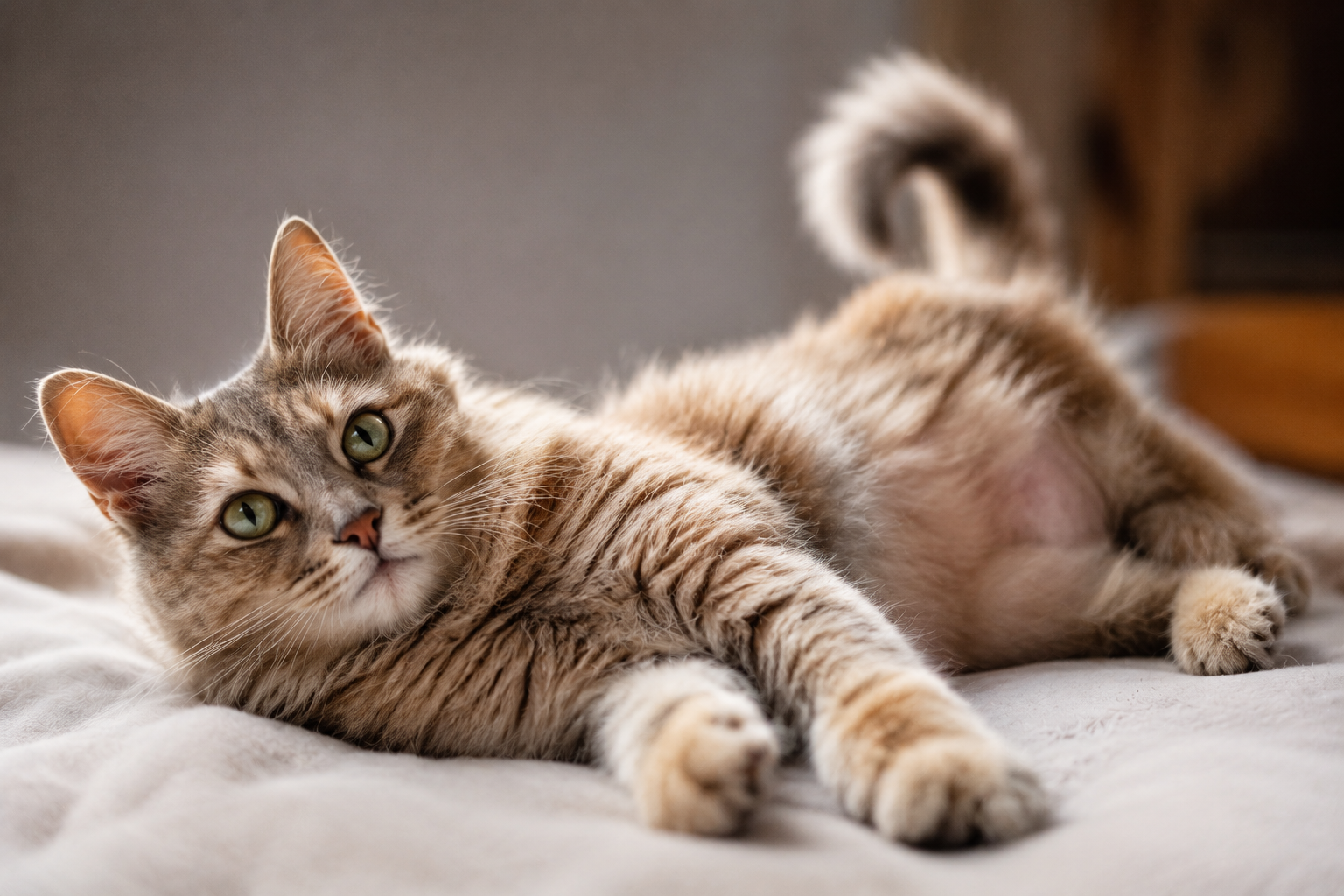
Has your female cat suddenly become exceptionally noisy, uneasy, and overwhelmingly loving- sometimes all of the above- You're most likely seeing your cat go through its first heat cycle. First-time cat owners can become quite alarmed and concerned by such an apparent change in behaviour- Could something be wrong? Is she hurting? Well, no, actually- she's fine, but she's in heat.
Identifying cat heat cycle signs can be among the most critical pieces of information you can have as an owner, regardless of whether you want to breed your cat, are thinking of spaying, or simply want to help your cat feel more at ease. We'll cover it all - phases, signs, time frame, and everything you can expect, right here.
What Is the Cat Heat Cycle?
The cat heat cycle, or medically termed as oestrus cycle, - is the reproductive cycle occurring from maturity to all unspayed female cats. Unusually, cats are ovulation reflex breeders; in other words, they only ovulate following copulation, not naturally. This means that a cat will not leave the heat stage until either mated or a natural oestrus period finishes, but without the above, or being neutered, the heat cycle will resume rapidly.
Normally, cats will be mature enough to have their first heat cycle between 4 and 10 months, but this will be dependent on the specific breed, as well as body mass and daylight. This is seasonal polyoestrus; in other words, the cat will go into multiple oestrus cycles during the peak breeding period, typically from spring through the late autumn in the Northern Hemisphere.
The Four Stages of the Cat Heat Cycle
The heat period of cat isn't actually just one period-it's a cycle composed of 4 stages. By knowing what each stage consists of, you will be able to accurately identify symptoms of a cat heat cycle and predict which will follow next:
Stage 1: Proestrus (1-2 days)
Proestrus is the phase of preparation for heat. During this period, the cat is just beginning to experience the first very subtle symptoms of the cat heat cycle that owners often fail to detect. They become a little more cuddly and rub up against objects and your legs more often, and may begin to meow a little more loudly, but they will not allow a male cat to mount.
-
Time Span: 1-2 days
-
Males begin to express interest
-
The female is restless but not yet accepting of the male
-
Almost undetectable by owners; can often be mistaken for a general shift in mood
Stage 2: Oestrus -True heat (5-10 days)
This is the period people usually refer to when talking about a cat's heat period. This stage contains the most noticeable and indisputable symptoms of the cat heat cycle. The female cat is now actively seeking male cats and allowing them to mount, so now is when we will address the question, "How long do cats stay in heat?" (typically 5-10 days unless mating occurs).
-
Time Span: 5-10 days
-
Excessive meowing: loud, constant yowls and cries
-
Rolls around and rubs against objects, and you
-
High rear and tilted tail (lordosis)
-
Affectionate and demanding attention
-
Attempts to escape outside and find a male
-
Loss of appetite in some females
-
Continual grooming of the genital area
Stage 3: Interestrus (7-14 days)
If a cat has not mated during her period of oestrus, she will now enter into a resting period called interoestrus, where the symptoms of the cat heat cycle will almost completely disappear. The cat's behaviour may return to normal, and owners may mistake it for the cycle being over.
-
Time Span: 7-14 days
-
Symptoms subside: the cat may seem to be herself again
-
Will not allow a male cat to mount
-
will repeat with proestrus happening again within a week or two
Stage 4: Anoestrus (seasonal rest)
Anoestrus is a period of seasonal reproductive inactivity that will normally occur during the shortened days of winter. A cat's heat period is entirely suspended during anoestrus; no symptoms of the cat heat cycle occur. Only cats that have cycles based on natural light will experience anoestrus; an indoor cat on artificial light may never experience this stage.
Signs of a Cat's Heat Cycle: A Full List
Now that you're acquainted with the stages, let's delve into the symptoms that signal your cat is in heat. These signs will be apparent mostly when your cat is in the oestrus stage (the heat phase itself).
-
Vocalising more than ever
One symptom that tends to take new cat owners off guard is extreme vocalisation. A cat in heat can be known to yowl, wail and cry with surprising volume; it may sound a little alarming and very unlike the voice you normally hear from her. One of the most distinctive signs of the cat heat cycle is a female cat crying at high volume in an effort to attract tomcats in the area. The vocalisation often happens at night and can persist for several days on end.
-
Lordosis posture
If you touch your cat on the back when she is in heat, you may find that she automatically arches her spine and raises her hindquarters, shifting her tail to one side. This stance is known as lordosis and is an unconscious signal that she is ready for mating. It is one of the clearest physical indicators that a cat is in heat cycle and is therefore at her most receptive stage.
-
More affectionate and restless than usual
A female cat in heat that is normally aloof or independent may become more attached to you and clingy, constantly demanding your attention. Your pet may continually rub against furniture, walls, other pets and people in the household. She may be incapable of settling at the same time – she may pace backwards and forwards, turn around and round in circles. Both of these are characteristic signs.
-
Escapism
The most practical of symptoms is the intense need to escape outside to find a male. Indoor cats may, if normally indifferent to the outdoors, attempt to dart out of doorways or through open windows at any available opportunity. There is great danger associated with this urge in the form of car accidents, fights with other cats and the risk of a pregnancy which should have been prevented by neutering.
-
Increased genital grooming
You will likely notice that your cat is attending to her genital and lower abdominal region with more than her usual grooming frequency. Unlike the dog's heat cycle, there will not usually be any blood in the discharge; if you notice blood, then seek advice from your vet, as it could mean something else.
-
Raised tail and treading of the hind legs
If you stroke your cat and she is in heat, her tail may be held stiffly erect or may swing sideways; the hind legs may make a characteristic treading movement. This is an involuntary, instinctive sexual display.
How Long Does a Cat Stay in Heat?
One of the most asked questions from people new to the signs of a cat's heat cycle is, " How long does a cat stay in heat? Here's the detail:
-
An individual phase of oestrus, or heat, will last for approximately 5 to 10 days.
-
If mating is successful, ovulation will occur, and heat will finish in just 24-48 hours
-
If mating is unsuccessful, interestrus will be entered (a rest period lasting 7 to 14 days), then the cycle will restart with another bout of heat.
-
The complete cycle of one heat phase to the next usually takes 2 to 3 weeks.
-
In the season, the cat will then have between 3 and 5 back-to-back heat phases; it is then said to be 'continuously in season.'
Therefore, one unspayed female cat can spend a great part of its year in a heat phase, and these events of the heat cycle are very stressful for both the mother cat and those caring for her.
What to Do When Your Cat Is in Heat
Once you know your cat is in heat, you need to know what to do about it. This is how to manage a cat in heat:
-
Keep her safe and indoors – make sure windows are shut, look for gaps under doors so she cannot get outside. Cats are highly motivated to search out a mate when they are in heat.
-
Provide extra comfort – offer her a comfortable, quiet space to rest. Some cats will respond well to petting, while others will not during high heat.
-
Don’t reprimand your cat when she is vocal – the yowling isn’t disobedience. Shouting will only make her feel worried.
-
Discuss spaying with your veterinarian – spaying is the only definitive way to stop a cat from entering heat. Spaying will remove all heat periods, prevent unwanted pregnancy and greatly reduce the incidence of uterine infections and mammary cancer.
-
Don't use any remedies without veterinary advice – some websites offer questionable home cures for cats in heat. Do not give your cat human medication or supplements without the advice of a vet.
Spaying: The Most Effective Solution
All veterinary organisations in the world over strongly recommend spaying if you do not intend to breed your cat. Spaying will not only prevent any signs of cat heat cycle, but will offer your female cat in heat significant health advantages, such as:
-
Eliminates ovarian cancer and uterine cancer in cats.
-
Significantly lowers the risk of mammary tumours, particularly if spayed before the cat's first heat cycle.
-
Prevents uterine infections (pyometra), which can kill cats.
-
Prevents unnecessary stress associated with recurrent heat cycles for the cat and the owner.
-
Prevents unwanted kittens – a huge welfare problem both in India and worldwide.
-
The optimum age to spay your cat is between 4 and 6 months of age, before your cat has her first heat cycle. Your cat can be spayed at any age, though, even while she is in heat (most vets like to wait for the cycle to finish, though, because the organs are more vascular, making them bleed more).
Final Thoughts: Know the Cycle, Help Your Cat
The symptoms of cat heat cycle can be intense, disruptive, and puzzling if you have never encountered them before. But when you know the signs, you can manage this with ease and understanding. Each sign your female cat in heat exhibits, from slight nervousness to outright, attention-seeking meows, stems from instinct, not ill behaviour.
The bottom line: Learn to detect early signs of heat in cats; understand how long does a cat stay in heat; protect her, and keep her enclosed during her heat cycle; seriously consider spaying if you aren't breeding. Your feline will thank you for this.
At Zoomies, we aim to make you every part of the way throughout your journey of being a cat parent, with reliable and veterinarian-approved info. Because each cat requires an owner who knows what to expect and how to take care of them.
FAQs
-
What does it mean when my cat is in heat?
When your cat is in heat, she is in a state of readiness to mate; she's in her breeding cycle. Female cats can become much more communicative, affectionate and restless at this stage, even exhibiting sexual activity, such as rolling around on the floor.
-
How long does a cat stay in heat?
A typical heat cycle will last roughly 4 to 7 days and, in some instances, can go on for a couple of weeks. If she is not mated while in heat, she will most likely come back into heat again in a couple of weeks.
-
What does it look like when a cat is in heat?
An affected cat will become excessively vocal, more affectionate and will try to rub her body against you and everything around her. She will also tend to roll on the floor, may be somewhat restless, will spray urine in your home and even hold her hindquarters in the air and tuck her tail to the side when you pick her up.
-
How often do cats go into heat?
Cats normally have around two to three heats each year, mostly through springtime and up until the beginning of autumn. Cats are what are known as seasonally polyestrous, meaning that they can come into season a number of times in a year.
-
What can I do to make my cat feel better when she's in heat?
The main thing to do is offer your cat a good amount of attention and play, and try to make sure her home environment is calm and stress-free. The most common thing to do to combat being in heat is to keep your cat inside so that she is not able to be mated and subsequently become pregnant. However, the only permanent way to prevent a cat from coming into heat is by spaying.
Share:
Symptoms of Tick Fever in Dogs: Causes, Treatment, and Diet
Cat Vomiting: Causes, Warning Signs, and What to Do When Your Cat Vomits