

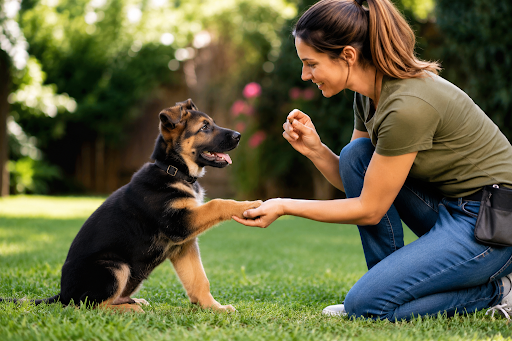
Dogs such as the German Shepherd are truly special - they are loving, smart, fiercely loyal, protective, and oh so full of character. But the one thing no one tells you on day one is this: training a German Shepherd puppy is a far cry from bringing home a trained German Shepherd puppy. The wonderful news is: knowing how to train your German Shepherd puppy is not only entirely possible even if this is your first ever dog: they consistently rank amongst the most trainable breeds of dog, and by having the right training plan on the day one when you bring your German Shepherd home you will continue to have a confident, and incredibly well behaved companion for the next twelve or fourteen years.
In this guide, we will take you through absolutely everything you will ever need to know when it comes to how to train a German Shepherd puppy, the very first minute you bring them home. We discuss the dog-training mindset, essential training elements, house training your German Shepherd puppy, your puppy's socialisation, potential problems and mistakes you will need to avoid at all costs, and how to develop the relationship with your dog that makes German Shepherd dogs the greatest of companions they are.
Why German Shepherd Puppies Respond So Well to Training
Before we look at the practical aspects of how to train a German Shepherd puppy, it's a good idea to briefly consider why German Shepherds are such an easily trained breed in the first place. German Shepherds were originally bred in late 19th-century Germany, and their role as herding and working dogs meant that intelligence, obedience, drive, focus, and the ability to quickly learn multiple tasks were highly desirable characteristics. These characteristics still make the breed a natural working animal today.
In a widely referred-to study on dog intelligence carried out by Canine Psychologist, Stanley Coren, German Shepherds came out third of all the dog breeds in working and obedience intelligence. A command will typically be learned within fewer than five repetitions, and a command already known will be obeyed on the first time more than ninety per cent of the time.
This is phenomenal responsiveness, and it means that in order for a German Shepherd puppy to avoid a buildup of bad habits, it must be presented with structure and not get bored or become frustrated. Problems can be created just as quickly as positive behaviours. German Shepherds' natural drive and intelligence mean that the puppy is always learning something, whether that something is being directly taught or being allowed to take its own initiative in acquiring unwanted habits. Consistent early training is simply not optional when it comes to this breed.
When to Start: The Critical Early Window
Perhaps one of the most important elements you will learn about training your German Shepherd puppy is the fact that training starts day one. A puppy's most critical socialisation period begins around 3 to 14 weeks of age. During this window, dogs are hardwired to receive, retain, and process new experiences, and the resulting associations formed shape their lifelong world-view. What your puppy does-and what they don't do-during this crucial stage has a permanent impact on personality and behaviour.
Since most puppies go to their homes between 8 and 12 weeks of age, you are already deep into this formative phase of your dog's life the moment they walk into your home. There is absolutely no reason to wait for puppy vaccinations to begin training. Name recognition, basic obedience commands, crate training and crate socialisation, and gentle socialisation with new people, dogs and environments should and must begin the day the puppy comes home.
Essential Commands: What to Teach First
As every first-time owner grapples with how to train a German Shepherd puppy, the number of command training subjects may seem overwhelming. Start your puppy's training off with these five commands and nothing else before you begin to train more advanced subjects. They are crucial for a puppy's safety and for a trainer to feel in control.
-
Sit
This is almost always the first command a puppy learns and the one that most will pick up very quickly. Take a treat from the front of the puppy's nose and pull it slowly over their head. Their nose will follow the treat upwards, causing them to lower their hind end to the floor. Once they've lowered themselves to a full sit, say your marker word, like "Yes!", and give the puppy the treat. After many repetitions, begin to give them the verbal command "Sit" just before they perform the behaviour. Most German Shepherd puppies can learn to reliably do a stay after 2 to 3 short training sessions.
-
Down
With a sit command established, bring a treat from the puppy's nose straight down in front of their nose and then move it slowly out away from them. You are training them to get their elbow to the ground. Mark the behaviour and reward the moment their hips reach the ground. A good sit-down is a very handy control command and can also be a natural state of being that is very calming. Training a puppy who knows a down command is generally much more manageable when situations are overwhelming.
-
Stay
Once a stay is dependable, it can be introduced. Have your puppy do a sit command. Hold your palm towards them in a stop position, step back one pace, wait one full second and then return to them, giving them the reward. The distance and duration must be increased over time. Stay is absolutely the most critical command for safety; any dog that is able to hold a stay while you open the front door is inherently safer than one that is able to flee through the doorway.
-
Come
Perhaps the single most important command your dog can learn is reliable recall. When you are training, your dog should always find coming to you the highlight of his or her day. Drop to your puppy's level, use a happy and excited tone of voice, and shower him or her with treats and physical affection when he or she gets to you. In the beginning, do not call your puppy to you and then do something unpleasant with him or her, like bathe him or her or trim his or her nails-these experiences will associate coming with unpleasant events.
-
Leave it
German Shepherd puppies are inquisitive and mouthing creatures and will chew and eat things that they should not. Leaving it gives a dog impulse control, and the ability to not approach danger when told is a lifesaving command for puppies. Take a treat and place it on the floor; cover the treat with your hand and wait until the puppy loses interest. The instant your puppy disengages from the treat, praise and reward him or her with another treat from the other hand. Work from there to having an uncovered treat and then objects left on the floor.
How to Train a German Shepherd Puppy at Home
House training can often be the first real hurdle faced by first-time puppy owners in the process of figuring out how to train a German Shepherd puppy. Thankfully, GSD's are clean dogs and most of them house-train very quickly compared to some other breeds, as long as consistent supervision is implemented. Consistency and constant vigilance are the keys.
Take your puppy out to the same place at the same times every day, morning, after every meal, after every nap, after every playtime and before bed. Puppies at this age (around 8 weeks) should be house trained every 2-3 hours. They do not hold it at night! Don't ask too much of a puppy too soon. It's by far the most frequent home training mistake new owners make.
Use a crate to house train your puppy. Dogs naturally do not want to soil their den. A correctly sized crate, one large enough for the puppy to stand, turn around, and lie down in, will help with nighttime bladder control.
Common First-Time Owner Mistakes
Understanding how to train a German Shepherd puppy also means understanding what not to do. The commonest mistakes include:
Inconsistency with commands:
If he's sometimes allowed on the sofa and sometimes not, how on earth will your puppy understand that's not what the rule is? Decide the family rules before your puppy arrives and adhere to them.
Leaving training until later:
"He's only a puppy" seems like a good excuse to allow bad habits to form, but it results in numerous problems with the adult dog. Start early with positive, kind training.
Punishment-based training.:
Corrections, dominance theory and alpha rolls have all been proven time and time again to be harmful and outdated techniques by recent science-based studies. They erode trust, can increase anxiety, and may provoke aggressive responses from a powerful breed such as the German Shepherd.
Lack of exercise and stimulation:
A bored German Shepherd puppy will amuse itself, and the chances are it'll be by using your furniture or garden as a chew toy and dig site! It cannot be stressed enough how vital daily exercise and mental stimulation (puzzle feeders, training and scent games) are to this breed.
Building the Bond: Training as a Relationship
The single most important thing to know about how to train your German Shepherd puppy is not one particular command or technique, but rather this: you do not train your German Shepherd. You partner with him. German Shepherd dogs form a unique bond of partnership with their owners. They learn, in the early weeks, that you "get" them and trust them with important things.
A correct diet plays a crucial role in your German Shepherd puppy's learning, development and health. When using treats for training purposes, make sure you pick soft, tiny, and low-calorie treats as you don't want to overfeed your puppy. Any food received for rewards should not account for more than 10% of your puppy's daily calorie intake. Many dog owners opt to give small bits of their puppy's food, even dry kibble, for their basic obedience training.
To further motivate your puppy while training, Zoomies Dog Treats could be an appropriate option. Their size is ideal to be easily taken as they come in small bite-sized pieces, hence perfect for obedience training and to reward good behaviour.
The time you spend training your puppy will, for the most part, be time you are building the most important relationship of your life for the next decade. A well-trained German Shepherd is not just an obedient animal, but a confident, quiet, content animal; and a confident, quiet, happy German Shepherd is perhaps the best dog of all.
Be patient. Be consistent. Make a big deal of the small successes. And have fun doing it, because it is the absolute greatest joy in life, watching a well-trained puppy evolve into an outstanding adult, to see him grow into an adoring, attentive, wonderful partner and friend.
FAQs
When can I start training my German Shepherd puppy?
You can begin basic training as early as 8 weeks of age. Focus on commands such as sit, stay, come, and leave it, emphasising positive reinforcement and consistency.
How should I train a German Shepherd puppy?
German Shepherd puppies respond best to reward-based training methods, using treats, praise, and play. Keep your training sessions brief, fun, and consistent.
How many times should I train my German Shepherd puppy each day?
Aim for 2-4 short, consistent training sessions per day, about 5-15 minutes in duration each.
How do I stop a German Shepherd puppy from biting?
Puppy biting is an expected part of development while your puppy is teething. Redirect unwanted chewing and biting behaviour towards acceptable chew toys, remove the dog when biting becomes too much, and reward calm behaviour.
When should I start socialising a German Shepherd puppy?
Socialisation should begin as early as possible, ideally between 8 to 16 weeks of age. Expose your puppy to a variety of new things in a safe, controlled manner, such as new people, sounds, locations, and other dogs, to help them grow into a confident adult dog.
Share:
Early Symptoms of Kidney Problems in Dogs You Should Not Ignore
How to Choose the Best Puppy Starter Food for Healthy Growth