

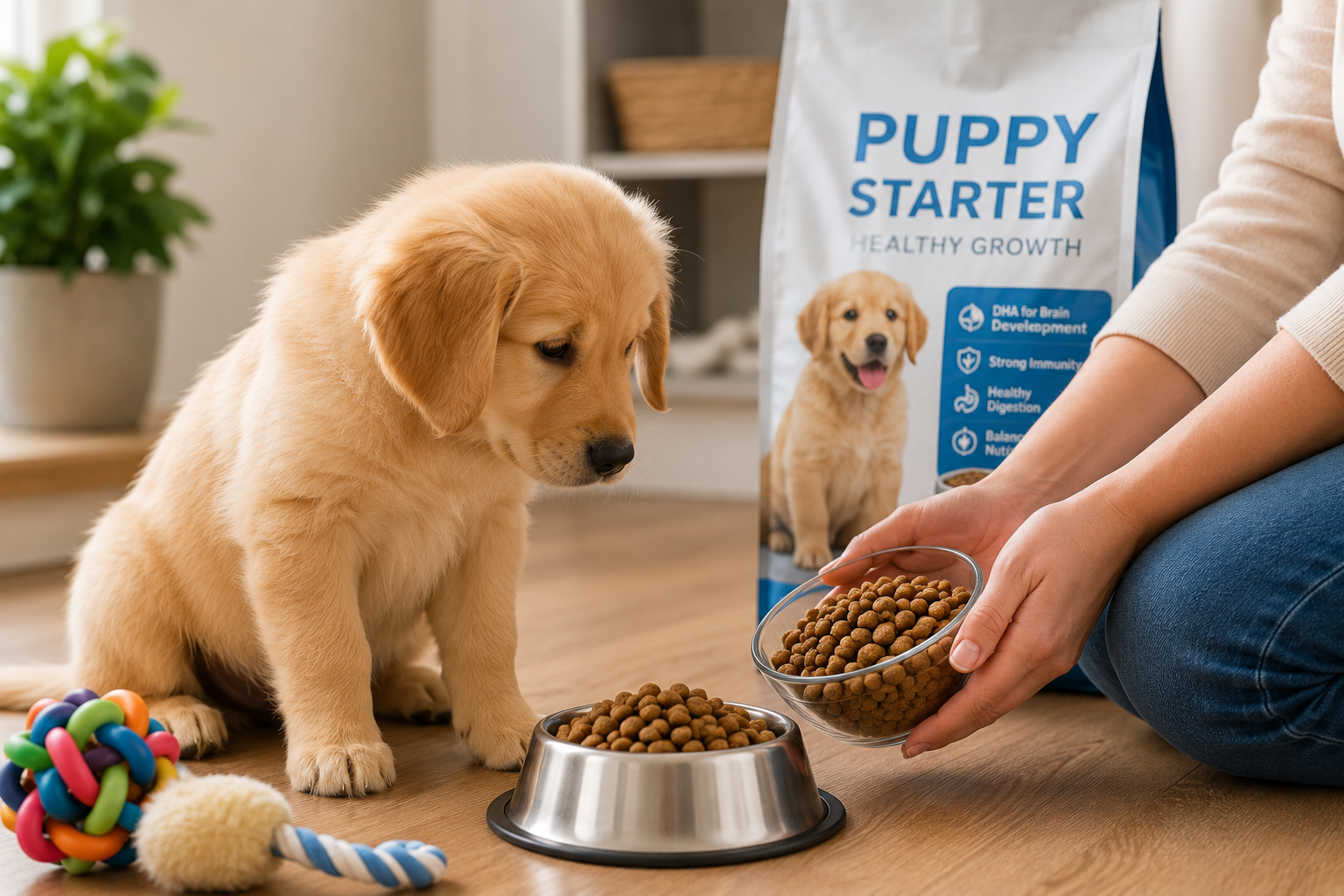
Walk into any pet shop or navigate online stores and you’ll find yourself surrounded by a range of puppy starter foods; all boasting about their appealing packaging and long list of scientific nutrients.
This can be quite confusing, especially if you’ve just purchased your first pet. However, there's absolutely no exaggeration in this claim since picking the best puppy starter food is indeed quite important; the reason being is that your pet's nutrition during his initial development stages will directly affect the development of bones, muscles, organs, immune and cognitive abilities. In other words, the right puppy starter food might be one of the most impactful decisions you'll make regarding your puppy.
In this guide, we'll talk about everything you need to know when shopping for your pet’s first food. Specifically, we’ll discuss how to recognize good puppy starter food, what nutrients matter and why, what you should know about dog food nutrition before making a choice, possible pitfalls to avoid, and considerations based on the particular puppy breed and weight.
Why Puppy Starter Food Is Different from Adult Dog Food
The nutritional needs of a puppy in its first few months are very different to those of an adult dog, and feeding a puppy an adult formula, even for a short period, can lead to actual nutritional deficiencies while they are at their fastest stage of growth.
Puppies are building everything. Bones to carry them for over ten years are calcifying, muscles are growing week on week, the brain and nervous system are maturing quickly, the digestive system is not yet fully established in processing nutrients and the immune system is still learning to fight the outside world. These growth processes demand more concentrated sources of protein, fat, calcium and phosphorous and a wider array of vitamins than are found in a food for an adult.
A puppy starter food which satisfies growth requirements will contain more concentrated minimums of protein, fat, calcium and phosphorous than a food for an adult, and will also require higher levels of DHA and several other vitamins. When you are scanning labels this should be your first stop: does this food meet AAFCO or FEDIAF standards for nutritional adequacy for growth?
The Key Nutrients to Look for in a Puppy Starter Food
By knowing what to look for, you can evaluate different brands with real authority, not just go by the claims made in their marketing materials. Here are the essential nutrients to look for in puppy starter food and what you should look for on the label:
Protein: The Most Critical Component
Protein is arguably the single most important macronutrient in any puppy starter food. This is because it provides the amino acids that puppies need to build and repair their tissues, maintain organ function and develop a strong immune system. The AAFCO requires a minimum of 22% crude protein on a dry matter basis for puppy foods, but most high-quality puppy starter foods boast much higher percentages between 25% and 32%.
Fat: Energy And Development
Puppies require considerably higher fat content than adult dogs. It is this essential component of their diet that provides their bodies with concentrated energy and aids them through their rapid rate of growth. Special fatty acids found in this nutrient also help to form the brain and the eyes. AAFCO recommends a minimum crude fat content of 8% in puppy foods, and good quality puppy starter foods typically offer a level of between 15% and 20% on a dry matter basis.
Calcium And Phosphorus: Achieving The Correct Ratio
Both calcium and phosphorus are crucial nutrients for development of the skeletal system, but their levels must be balanced correctly with each other. The optimum ratio for calcium to phosphorus is generally considered to be between 1:1 and 2:1 for puppy starter food. Problems arise from excessive calcium, often caused by owners adding extra calcium supplements on top of an already nutritionally complete food; it inhibits bone formation, particularly in large or giant breeds. You should never supplement calcium unless advised to by a veterinary nutritionist.
Vitamins And Minerals
A complete and balanced puppy starter food will contain a full range of vitamins and minerals essential to puppy growth and development. Those that you should look for include vitamin D (which is responsible for calcium absorption and mineralisation of the bone), vitamin E (which offers antioxidant support and promotes immune function) as well as zinc and iron (essential for coat, skin and immune support as well as red blood cell formation respectively). Any food that meets the AAFCO growth standards will have at least the minimal required levels of all of these nutrients. The question here is whether the formula meets or exceeds these minimum standards and if it provides these micronutrients through high-quality, biologically available ingredients.
Puppy Starter Food Nutrient Quick Reference
Use this table as a starting point when evaluating labels:
|
Nutrient |
Why It Matters |
What to Look For |
|
Protein |
Muscle, organ, immune development |
Min 22% DM; named meat as first ingredient |
|
Fat |
Energy, brain and eye development |
Min 8% DM; fish oil or salmon for DHA |
|
DHA (Omega-3) |
Cognitive and visual development |
Listed in ingredients or highlighted |
|
Calcium |
Bone and teeth formation |
0.5–1.8% DM; Ca:P ratio 1:1 to 2:1 |
|
Phosphorus |
Bone structure, energy metabolism |
Balanced with calcium |
|
Vitamin D |
Calcium absorption, bone health |
Included in all complete formulas |
|
Zinc & Iron |
Skin, coat, immune, blood health |
Listed in mineral supplements section |
Breed Size Matters: Choosing Puppy Starter Food for Small, Medium, and Large Breeds
Probably the most significant, yet often ignored, step in selecting a puppy starter food is to select one tailored to the anticipated adult size of your puppy. Nutritional requirements differ significantly in small, medium and large breeds during development and not all puppy foods are created equal.
Small and Toy Breeds: Puppies predicted to weigh under 10kg as adults possess a far faster metabolic rate than large breeds and mature to their adult size between nine and twelve months of age. Small breed puppy starters are therefore made with a higher calorific value per gram, contain very small kibble to match the smaller jaw size and may be transitioned to adult food far sooner than large breeds.
Medium Breeds: Medium breed puppies (under 25kg as adults) will be well catered for with standard all-life-stages or medium breed specific puppy starters. Growth is moderate and full physical maturation usually occurs by twelve months. The nutritional issues facing medium breed puppies are less severe than those faced by large breed puppies but a diet that contains quality protein and balanced calcium with DHA supplement is still essential.
Large and Giant Breeds: When a puppy is destined to reach over 25kg in adulthood, appropriate puppy starter food selection becomes crucial. Large and giant breeds possess rapid, prolonged growth patterns; an over-rich diet or too high an amount of calcium during the growing period will be responsible for development of orthopaedic disease- this condition covers a range of bone and joint afflictions such as hip dysplasia, osteochondrosis and panosteitis; they are painful, irreversible conditions linked very strongly with improper nutrition.
Large breed puppy starters are designed with moderate levels of calcium and moderate protein levels and with calorific values to promote sustained healthy growth rather than accelerated growth. Rapid growth in large breeds is detrimental to the long term health of joints; standard puppy foods and all life-stage formulas should not be used.
Zoomies Reminder: Ensure that a large breed puppy starter food states clearly that it is for large breeds; calcium levels should be between 0.7- 1.2% dry matter which is less than a standard puppy food and your vet can confirm this for you.
Wet, dry or mixed? Deciding the best option
Puppies starter food is available as a dry kibble, wet/canned and also in raw or semi-moist forms. They all have advantages and practical disadvantages.
Dry kibbles are very common for obvious reasons; convenience, cost and calorie density as well as storage space. Their dry texture also helps to provide a mildly mechanical cleaning effect to the teeth. When young puppies have to be switched to solids or during the transition from their mothers, dry kibbles can be softened by moistening with warm water.
Wet foods typically have high moisture content, around 75-80%, providing significant hydration to the diet and most puppies find them irresistible. They can be more expensive per calorie compared to dry foods and will deteriorate rapidly after the tin is opened; some owners only use these as additions or treats to the diet.
Mixed feeding (a mix of dry kibble and wet food) is often perceived as the 'happy medium'. It is considered to have the hydration benefits and palatable nature of wet food with the convenience and dental benefits of dry kibble.
Red Flags to Avoid When Choosing a Puppy Starter Food
Many puppy starter foods can fool you with the way they are marketed, masking a mediocre formula. Here is what you should look out for:
Lack of AAFCO or FEDIAF adequacy statement: Without an official statement, you cannot be guaranteed the puppy starter food fulfills the minimum growth requirements, which means you should just walk away.
Undefined protein sources: Names like 'meat meal', 'animal by-products' or 'poultry digest' without defining the source animal are a warning of a lack of transparency. High quality starter foods will name the sources of the protein.
High level fillers that are repeatedly used: Wheat middlings, corn syrup, and multiple kinds of grain showing up in the ingredients indicate they are simply cheapening the calories in the formula by repeating a cheap filler multiple times under different names ('ingredient splitting').
Artificial preservatives: Artificial preservatives such as ethoxyquin, BHA, and BHT are related to serious health concerns in high dosages. Companies that make high quality starter foods use natural preservatives such as mixed tocopherols and rosemary extract instead.
Artificial colors and flavoring: Puppies do not require that their food be red or green in color for it to be attractive. Artificial coloring is added only for the buyer, so if it is added, it is a minor warning of how you should view the rest of the formula.
Bringing It All Together
Choosing the best starter food for your puppy shouldn’t be difficult, but you do need to focus on the right factors. Begin with AAFCO approval and the presence of identifiable animal protein, along with a DHA source. Also, choose the right formula for your puppy's breed size, particularly if it is a large to giant breed. Don't take everything written on the bag at face value, watch out for "red flags", and dismiss packaging promises if they aren't supported by the ingredient list and nutritional profile.
Puppyhood passes quickly; most of your puppy's physical development happens in the first 12 to 18 months and the nutritional choices you make early in life can actually impact the way your puppy feels for years. Choosing a quality puppy starter food isn't a treat; it's truly the single most evidentially-based factor.
Explore the Zoomies puppy nutrition hub to find breed specific food suggestions, feeding charts, and products recommended by veterinarians. We want to assist you in setting your puppy up for a perfect beginning.
FAQs
What is the best starter food for a puppy?
The best starter food is high-quality puppy formula, which is specially designed to offer the necessary protein, healthy fats, vitamins, and minerals required to meet your puppy's growth needs. For a puppy food, look for the word 'puppy' on the label.
When can puppies start eating solid food?
At around three to four weeks, puppies may begin to eat a puppy-starter food that has been softened with water or puppy milk replacer.
How many times a day should I feed my puppy?
Typically three to four small servings of food a day should be given to a puppy up until the age of approximately six months, at which time the number of meals a day should begin to reduce.
Can I give my puppy homemade food?
Yes, but this diet needs to be nutritionally complete for puppies. Talk to a veterinarian or pet nutritionist before making this change for good.
What foods should puppies avoid?
Puppies, like all dogs, cannot have food which is toxic to them such as; chocolate, raisins, grapes, onions, garlic, xylitol, alcohol, or overly fatty foods.
Share:
How to Train a German Shepherd Puppy: Tips for First-Time Owners
10 Best Dog Foods for Sensitive Stomach