

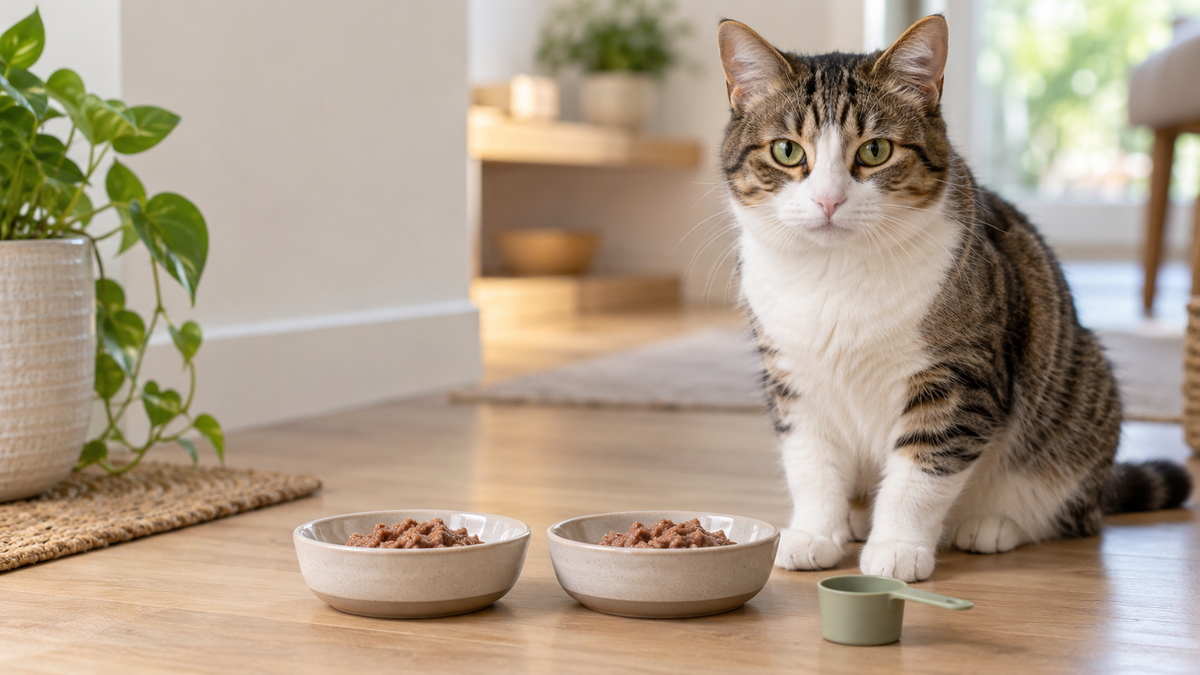
If you've ever stood in front of the pantry wondering how much wet food should a cat eat, you're not alone. It's one of the most common questions cat parents ask, and the honest answer is: it depends. Your cat's ideal cat wet food quantity is shaped by their weight, age, activity level, and overall health - which means there's no single number that works for every cat. That said, there are reliable guidelines, calculations, and feeding charts that can get you very close to the right amount, and that's exactly what this guide is is here to help with.
Why Getting Wet Food Portions Right Matters
Before diving into numbers, it's worth understanding why wet food portions for cats deserve real attention rather than a rough guess. Feed too little, and your cat may lose weight, feel constantly hungry, or miss out on key nutrients. Feed too much, and you risk gradual weight gain that can snowball into obesity, joint stress, diabetes, and other long-term health issues. Getting portion sizes right isn't just about keeping your cat satisfied at mealtime - it's one of the most direct ways you can support their long-term health.
Wet food also plays a unique role in a cat's diet beyond calories. Cats evolved as desert-adapted hunters who got most of their water from prey, which means many cats don't drink enough water on their own. Wet food, with its high moisture content, helps fill that gap - supporting kidney and urinary tract health in a way dry kibble alone can't.
How Much Wet Food Should a Cat Eat? The General Rule
So, how much wet food should a cat eat on a typical day? As a general starting point, most healthy adult cats need approximately 20 to 30 calories per pound of their ideal body weight each day. A typical 3-ounce can of wet food contains roughly 70 to 100 calories, while a larger 5.5-ounce can typically contains 120 to 150 calories.
Putting that into practice, a healthy 10-pound adult cat eating an all-wet-food diet generally needs about 200 to 300 calories a day, which translates to roughly two to three 3-ounce cans, or about one and a half to two of the larger 5.5-ounce cans. This is a helpful baseline for figuring out cat wet food quantity, but it's exactly that - a baseline. Your cat's actual needs may run higher or lower depending on the factors we'll cover next.
Wet Food Portions for Cats, by Body Weight
Because body weight has such a direct impact on calorie needs, one of the simplest ways to estimate wet food portions for cats is to work from a weight-based chart. As a general guide:
-
Small cats (around 4-7 lbs): roughly 150-200 grams of wet food per day
-
Medium cats (around 8-11 lbs): roughly 200-250 grams of wet food per day
-
Large cats (12+ lbs): roughly 250-300 grams of wet food per day
Another commonly used rule of thumb is to feed one 3-ounce can for every 3 to 3.5 pounds of your cat's body weight per day. So an 8-to-10-pound adult cat would generally land somewhere around 2.5 to 3 cans daily, while a smaller 6-pound cat might need closer to 1.5 to 2 cans.
These figures assume wet food is your cat's only food source. If your cat also eats dry kibble or regular treats, you'll need to adjust the wet food portion downward to avoid overfeeding overall, since those extra calories add up quickly in a small-bodied animal like a cat.
How Many Wet Food Pouches per Day Should You Feed?
If you're using pouches rather than cans, the math works a little differently, since pouch sizes and calorie densities vary more between brands. Many cat food pouches are smaller than a standard can - often in the 2.8 to 3 ounce range - and contain roughly 60 to 85 calories each, though this varies significantly by brand and recipe.
For most adult cats, the answer to how many wet food pouches per day comes down to matching daily calorie needs against the calorie count on your specific pouch's label:
-
A lean adult cat (around 8-10 lbs) typically needs the equivalent of about 2 to 3 pouches per day, split across two or three meals
-
A smaller adult cat (around 5-7 lbs) often does well with about 1.5 to 2 pouches per day
-
A larger adult cat (12+ lbs) may need closer to 3 to 4 pouches per day
Because pouch sizes and calorie content vary so much between brands, always check the calorie information printed on the packaging rather than relying purely on a pouch count. Two pouches from different brands can have meaningfully different calorie totals, so the number of pouches matters less than the total calories they add up to.
Adult Cat Feeding Guide: Factors That Change the Numbers
A solid adult cat feeding guide has to go beyond weight alone, because several other factors meaningfully shift how much wet food a cat should eat.
Age. Adult cats between about 1 and 7 years old generally do well on the standard calorie ranges described above. Senior cats, typically those 7 years and older, often need slightly less food due to lower activity levels and reduced muscle mass - though some senior cats with health conditions may actually need more calories, so it's worth checking with your vet.
Activity level. An indoor cat who spends most of the day napping will burn noticeably fewer calories than an active cat who climbs, plays, and explores throughout the day. If your cat is more of a couch potato, lean toward the lower end of the calorie range (around 20 calories per pound); if they're highly active, the higher end (around 30 calories per pound) may be more appropriate.
Body condition. Ideal weight and current weight aren't always the same thing. If your cat is currently overweight, portioning based on their current weight will only maintain the excess weight rather than help them reach a healthier one. In these cases, it's better to calculate portions based on their ideal body weight, ideally with guidance from your veterinarian.
Spay/neuter status. Spayed and neutered cats tend to have slightly lower metabolic rates than intact cats, which can mean slightly reduced calorie needs. This is one reason many cats gain weight after being spayed or neutered if portions aren't adjusted afterward.
Health conditions. Cats managing certain health conditions, such as kidney disease, diabetes, or hyperthyroidism, often have very different nutritional needs than a healthy adult cat. If your cat has an ongoing health condition, your vet's specific feeding recommendations should always take priority over general guidelines.
Life stage. Kittens have significantly higher energy needs relative to their body weight because they're growing rapidly. Kittens typically need several smaller meals throughout the day - often three to four - rather than the two meals that work well for most adults. Pregnant and nursing cats also need substantially more calories, sometimes two to three times an adult cat's normal intake, to support their own health along with their kittens'.
How Often Should You Feed Wet Food?
Meal frequency is just as important as total quantity when figuring out wet food portions for cats. Most adult cats do well with two to three meals a day, spaced roughly 8 to 12 hours apart. This mimics a more natural feeding rhythm for cats, who in the wild would eat multiple small meals rather than one or two large ones.
Kittens, because of their higher energy needs and smaller stomach capacity, generally need three to four smaller meals spread throughout the day. Senior cats often continue well with two to three meals daily, though appetite changes are common with age and may require adjusting portion sizes or frequency over time.
If you free-feed wet food (leaving it out all day), it's worth noting that wet food spoils much faster than dry kibble once opened or served, generally within two to four hours at room temperature. For this reason, most vets recommend scheduled meals over free-feeding when it comes to wet food specifically.
How to Calculate Your Cat's Exact Portion
If you want a more precise answer than a general range, here's a simple way to calculate cat wet food quantity for your specific cat:
-
Determine your cat's ideal body weight. If you're not sure whether your cat is at a healthy weight, ask your vet for a body condition assessment.
-
Multiply that weight by 20 to 30 calories per pound, depending on activity level. Use the lower end for less active cats and the higher end for more active ones.
-
Check the calorie content on your food's label. Most cans and pouches list calories per unit (often as kcal per can, pouch, or 100 grams).
-
Divide your cat's daily calorie target by the calories per can or pouch to get the number of servings needed per day.
-
Split that total across two to three meals, adjusting portions slightly based on your cat's appetite and body condition over time.
This calculation gives you a genuinely tailored answer to how much wet food should a cat eat, rather than relying purely on a generic chart that may not reflect your cat's specific food or needs.
Signs You May Need to Adjust Portions
Even with a solid calculation, it's worth watching your cat's body condition and behavior over time, since feeding needs can shift. Signs you may be feeding too little include a cat who seems constantly hungry, is losing weight, or has a noticeably thinning coat. Signs you may be feeding too much include gradual weight gain, a rounded midsection that doesn't taper at the waist, or leftover food that goes uneaten at most meals.
Regular vet checkups are one of the best ways to catch these shifts early, especially since weight changes in cats can happen gradually and be easy to miss day to day. Most vets recommend a hands-on weight check every few months, since visual changes alone aren't always reliable in cats with thick or fluffy coats.
The Bottom Line
There's no single universal answer to how much wet food should a cat eat, but there is a reliable process for figuring it out: start with a calorie-based calculation using your cat's ideal weight and activity level, use the feeding chart on your specific food's label as a starting point, and adjust based on your cat's actual body condition over time. As a general reference, most healthy adult cats need somewhere between 200 and 300 calories a day from wet food, which usually works out to about two to three standard cans or two to three pouches, depending on the brand's calorie density.
Every cat is a little different, and this adult cat feeding guide is meant as a starting point rather than a strict rule. If you're ever unsure about the right wet food portions for cats in your household - especially for kittens, senior cats, or cats managing a health condition - your veterinarian is always the best resource for a feeding plan tailored specifically to your cat.
FAQs
1. How much wet food should an adult cat eat per day?
The ideal amount depends on the cat’s weight, age, activity level, health, and the calorie content of the food. As a general guide, a healthy 4-5 kg adult cat may need roughly 200-300 calories per day when eating wet food exclusively. Always use the feeding recommendations on the specific food package as a starting point.
2. How should wet food portions be divided for cats?
The daily portion can be divided into two or more meals rather than served all at once. Smaller portions can help maintain a consistent feeding routine and may work particularly well for cats that prefer frequent meals.
3. How many wet food pouches should a cat have per day?
There is no universal number because pouch sizes and calorie densities vary between brands. For example, some feeding guides recommend around 2-3 pouches daily for a 3-5 kg adult cat, while other products recommend more or less. Check the calorie content and feeding chart on the pouch rather than relying on pouch count alone.
4. What is a good adult cat feeding guide for wet food?
A practical adult cat feeding guide should consider body weight, activity level, neuter status, and whether dry food or treats are also given. For cats eating both wet and dry food, the wet portion should be reduced to account for calories from the dry food.
5. Can feeding too much wet food cause a cat to gain weight?
Yes. Although wet food contains a high proportion of water, it still provides calories. Feeding portions that exceed a cat’s daily energy needs can contribute to weight gain. Portions should be adjusted based on body condition, weight changes, activity, and other foods or treats included in the diet.
Share:
Best Foods for Himalayan Cats in 2026: Vet-Recommended
Best Cat Food for Picky Eaters: Guide to Making Mealtimes Easier